Building blocks may look like child’s play, but they are turning out to be a surprisingly powerful way to untangle complex facility management challenges.
Everyone knows LEGO. What far fewer people know is that, at the end of the 1990s, the LEGO Group developed a dedicated methodology for facilitating workshops and change processes in organizations: LEGO Serious Play (LSP). It is a globally recognized method that taps into participants’ imagination and creativity and channels it towards complex, real-world questions — including the kind of operational and spatial puzzles that facility managers face every day.
Why it works: thinking with your hands
LSP rests on two principles: the power of the metaphor and the power of the story. Participants build a model in answer to a question, then explain what they built. A single white brick can stand for a dangerous polar bear — no advanced building skills required. This deliberate simplicity is exactly what makes the method inclusive: everyone can take part, and everyone is heard.
Because people build before they speak, the method bypasses the usual meeting dynamics where the loudest voice dominates. A core rule keeps the focus where it belongs: “the model speaks, not the person.” There are no wrong answers and no criticism of each other’s creations. The result is a safe, participatory setting in which all the knowledge present in a team is unlocked, weighed and anchored — with a genuine long-term effect.

The added value for facility management questions
Facility management is, by nature, a domain of complexity: overlapping responsibilities, shared spaces, invisible processes and stakeholders who each see only part of the picture. These are precisely the issues where conventional discussion tends to stall. LSP makes that complexity tangible and discussable.
By visualizing roles, tasks and processes as physical models, a facility team can literally see how its parts connect. Essential relationships are made explicit by linking models together with specific bricks, and bottlenecks that normally remain hidden suddenly become visible to everyone in the room. Storytelling adds the context, emotions and underlying assumptions that a spreadsheet or org chart can never capture, which in turn fuels deep, solution-oriented discussion and strengthens team cohesion.
From theory to practice
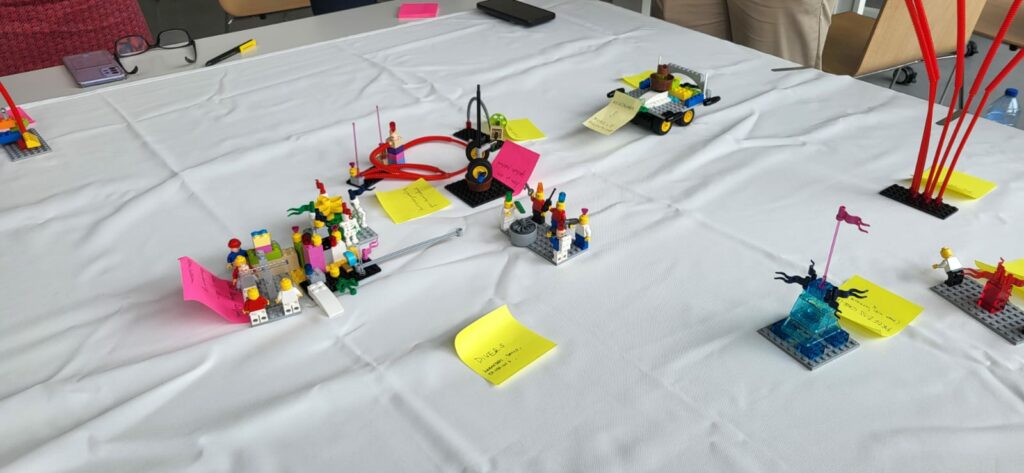
I recently had the opportunity to use LSP, during a one-day workshop, to map out the operation of an entire facility management team of ten people. We started from each member’s personal assignment, then modelled the various team responsibilities one by one. The individual explanations alone immediately sparked in-depth, clarifying discussions.
At the end of the session, the participants combined all their individual models into a single overarching structure in which every team member could find their place. The shared processes were thoroughly mapped out — and, tellingly, the team arrived at concrete improvement proposals entirely on their own. That is the real promise of LEGO Serious Play for facility management: not playing with bricks, but turning a complex, half-visible operation into a shared landscape that a team can understand, own and improve together.
Blog by Anton Maes – IFMA Belgium boardmember